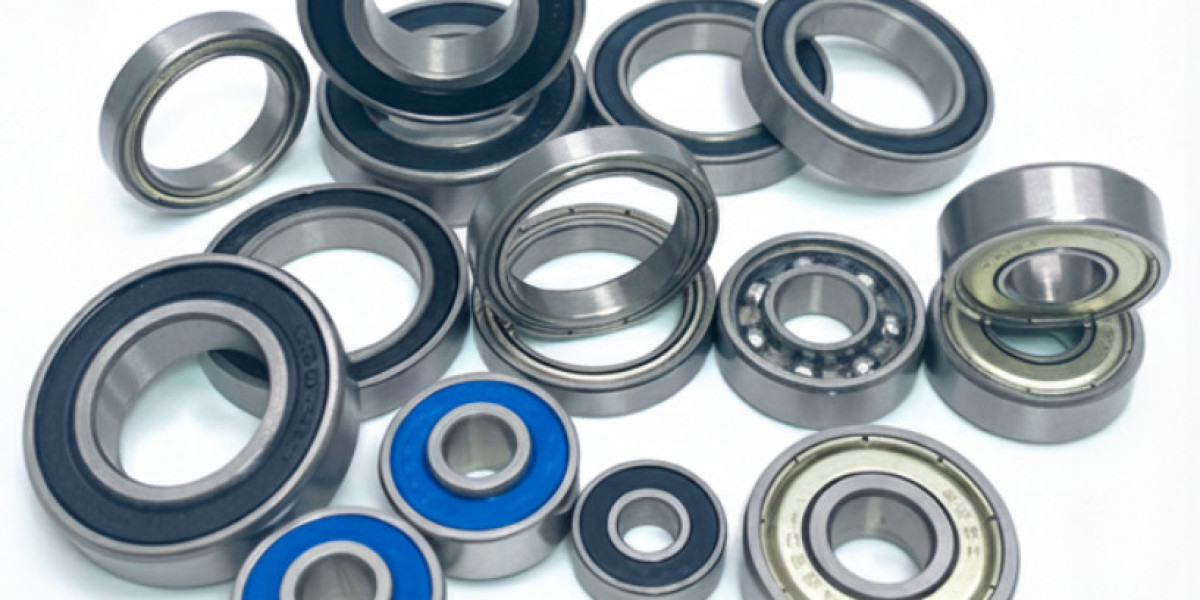

Deep Groove Ball Bearings are one of the most widely used rolling element bearing types in modern mechanical systems. Their popularity comes from a simple yet highly efficient structure that supports both radial and limited axial loads while maintaining low friction and stable rotation at high speeds.
At the core of their design are four main components: the inner ring, outer ring, steel balls, and cage. The inner and outer rings contain deep raceway grooves with a curvature slightly larger than the ball diameter, typically designed around a groove radius ratio close to 0.52 times the ball diameter. This geometry ensures smooth rolling contact and reduced stress concentration.
In most standard configurations, the bearings follow ISO boundary dimensions such as the 6000, 6200, and 6300 series. For example, a 6205 bearing often features an inner diameter of 25 mm, outer diameter of 52 mm, and width of 15 mm. These standardized dimensions allow easy replacement across industries.
The cage is commonly manufactured from pressed steel or reinforced polymer, helping to maintain uniform spacing between rolling elements. Lubrication is usually grease-based for sealed variants, allowing long maintenance intervals in enclosed systems.
Deep Groove Ball Bearings are commonly used in electric motors, pumps, fans, conveyors, and automotive components due to their ability to operate at speeds exceeding 10,000 RPM in certain configurations. Their dynamic load ratings vary widely depending on size, ranging from a few kilonewtons in miniature bearings to over 50 kN in heavy-duty models.
Because of their balanced design, these bearings are considered a general-purpose solution for rotating machinery requiring stability, efficiency, and low noise operation.