
Umm Al Quwain is rapidly redefining its economic identity within the United Arab Emirates. Once known as the smallest emirate in terms of economic output, the region has recently demonstrated extraordinary momentum through industrial expansion and international trade growth. In 2024, the emirate recorded export growth of nearly 399 percent, with the total export value reaching approximately AED 15.1 billion. This transformation has positioned Umm Al Quwain as an emerging manufacturing and logistics hub within the country. With the government’s Vision 2033 strategy targeting annual GDP growth of around 6 percent through economic diversification, sectors such as advanced manufacturing, healthcare, and education are expanding quickly. As these industries grow, the demand for modern laboratory infrastructure—capable of supporting research, testing, and quality assurance—has increased significantly.
Laboratories have become an essential component of this economic evolution. The emirate now hosts more than 267 manufacturing companies operating across sectors that include steel production, specialty chemicals, construction materials, and industrial components. A notable development in this transformation is the AED 441 million investment in advanced steel manufacturing facilities, which has strengthened Umm Al Quwain’s industrial capabilities. At the same time, the emirate is building its reputation as a logistics and export center due to its strategic coastal location and expanding port infrastructure. These developments require advanced analytical laboratories for product testing, environmental monitoring, and compliance with international trade standards. For companies operating in such high-precision industries, reliable laboratory environments are no longer optional—they are fundamental to maintaining competitiveness and regulatory compliance.
Market trends across the UAE further reinforce this demand. The laboratory equipment and furniture market in the country was valued at approximately $220 million in 2024 and is projected to reach around $290 million by the end of the decade, reflecting steady industry expansion. Clinical laboratory services are also growing as healthcare infrastructure expands, with the sector estimated at more than $1.5 billion and expected to surpass $2 billion by 2030. These figures highlight the increasing importance of advanced laboratory systems across industries, from industrial manufacturing to healthcare diagnostics.
Services: https://www.idealabsuae.com/umm-al-quwain/services
Manufacturing remains one of the strongest drivers of laboratory demand in Umm Al Quwain. The emirate’s industrial renaissance is particularly visible in the steel production sector, where a consortium including companies such as CIM Steel Industry, Rhino Steel, Metal Care Center Factory, and Aziz Steel is developing the region’s first fully automated continuous coating line with an annual capacity of approximately 500,000 metric tons. Facilities of this scale require specialized testing laboratories equipped with corrosion-resistant work surfaces, advanced instrumentation, and automated analysis systems. Such laboratories play a crucial role in maintaining consistent product quality and ensuring that materials meet both domestic and international standards.
Healthcare development is another factor driving the need for laboratory infrastructure. Despite its relatively small population of around 76,700 residents, Umm Al Quwain has steadily expanded its healthcare network. Modern facilities such as Sheikh Khalifa General Hospital, Thumbay Hospital UAQ, and Care4U Medical Centre provide a wide range of diagnostic and treatment services. These institutions depend heavily on clinical laboratories capable of performing microbiology, pathology, and biochemical testing with precision and efficiency. As healthcare providers expand their services, the need for reliable laboratory systems continues to increase.
Education and academic research also contribute to this growing demand. Umm Al Quwain University, established in 2012 and fully accredited, offers programs in science, arts, and business administration. Universities rely on modern teaching laboratories that allow students to gain practical scientific experience while supporting faculty research. As the university expands its academic offerings, it requires advanced laboratory environments equipped with safety systems, specialized equipment, and efficient workflow design.
The emirate’s commitment to sustainability further amplifies the importance of laboratory infrastructure. Government plans aim to generate around 25 percent of the emirate’s energy from renewable sources by 2030. Achieving this target requires laboratories capable of conducting environmental testing, monitoring water quality, and analyzing ecological conditions. Umm Al Quwain’s coastal ecosystems, including mangrove habitats and marine biodiversity, require ongoing scientific monitoring to ensure that development remains environmentally responsible.
Logistics and international trade represent another area where laboratory capabilities are essential. With the expansion of Ahmed Bin Rashid Port and the emirate’s growing role in cargo handling, testing facilities are required to ensure compliance with global standards. Laboratories responsible for food safety testing, cargo inspection, and material certification help facilitate international trade by verifying that exported products meet regulatory requirements in global markets.
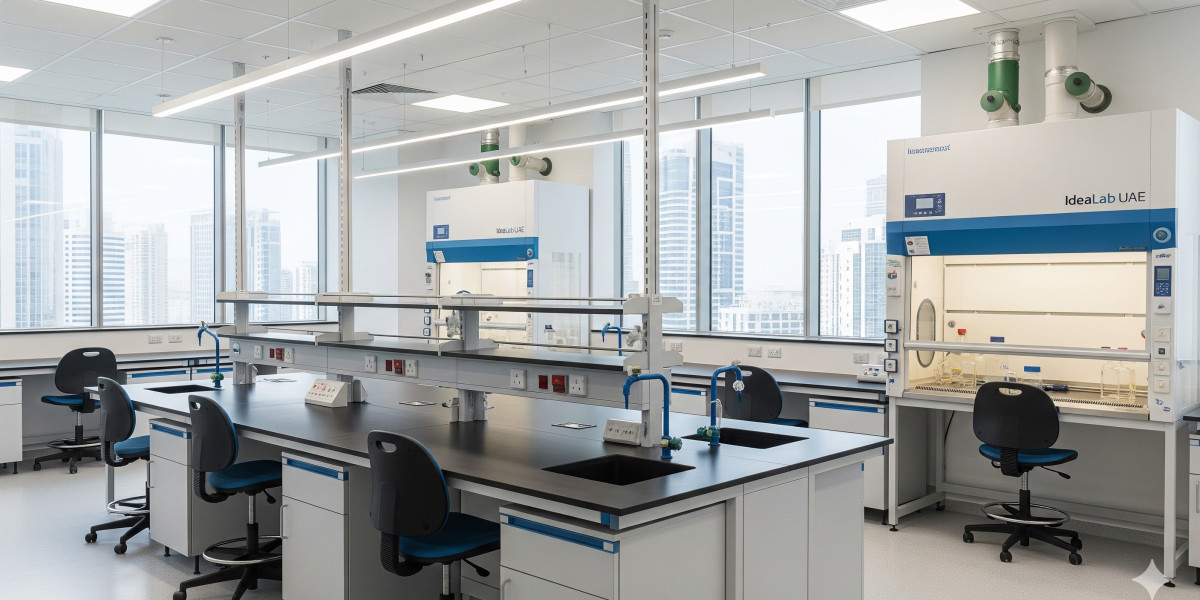
To support these diverse industries, laboratory design must integrate several critical components. Durable work surfaces such as epoxy resin or stainless steel are required to withstand corrosive chemicals used in industrial analysis. Precision instrumentation often requires vibration-isolated tables to ensure measurement accuracy, especially in manufacturing quality control laboratories. Safety systems, including advanced fume hoods, gas monitoring equipment, and emergency response installations, protect personnel working with hazardous materials. Cleanroom environments are also essential for industries that require contamination-free processes, particularly in advanced manufacturing and pharmaceutical production.
Environmental control systems play a vital role as well. Given the region’s hot climate and industrial activity, laboratories must maintain stable temperature and humidity conditions to protect sensitive instruments and maintain sample integrity. Modern laboratories also rely on digital systems such as Laboratory Information Management Systems (LIMS), which streamline data management, sample tracking, and compliance documentation.
As Umm Al Quwain continues its economic transformation, the importance of sophisticated laboratory infrastructure will only increase. Whether supporting industrial production, healthcare diagnostics, academic research, or environmental monitoring, laboratories form the backbone of modern scientific and technological progress. By enabling accurate testing, efficient workflows, and regulatory compliance, advanced laboratory systems help ensure that the emirate’s ambitious growth plans remain sustainable and globallycompetitive