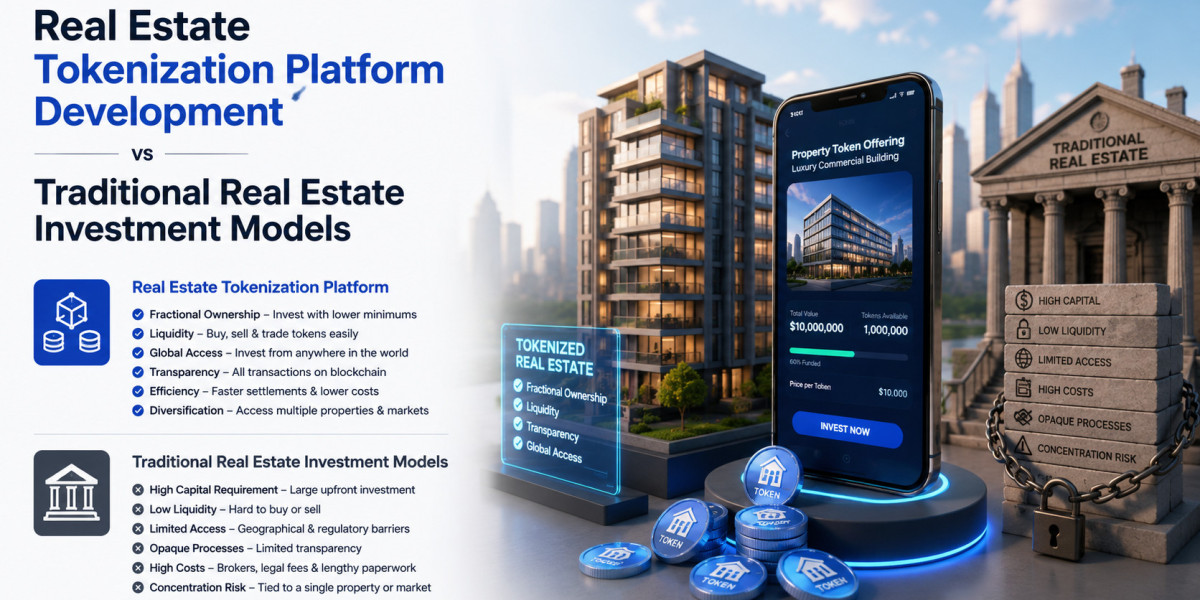

Real estate investment has long been dominated by conventional ownership structures, where property buyers rely on large capital commitments, lengthy paperwork, and restricted liquidity. With the arrival of digital financial systems, Real Estate Tokenization Platform Development has introduced a new model where property value can be represented through digital tokens on blockchain-based systems. This shift has created a clear contrast with traditional real estate investment models in terms of access, ownership structure, and transaction flow.
Traditional systems still depend on intermediaries, physical documentation, and regional market limitations. On the other hand, real estate asset tokenization introduces digital representation of property shares, allowing fractional participation and broader investor access. This comparison highlights how both systems function and where they differ in structure, participation, and operational methods.
Understanding Traditional Real Estate Investment Models
Traditional real estate investment involves direct property purchase, real estate investment trusts, or joint ownership structures. Investors typically acquire full or partial ownership through legal agreements and registered documents. Transactions often pass through brokers, banks, legal advisors, and government registration offices.
Liquidity in this model is limited since selling property requires time, negotiations, and market dependency. Entry barriers are also high due to capital requirements, making participation difficult for small investors. Property management, taxation, and maintenance responsibilities remain with the owner or managing agency.
Real estate markets under this model are heavily influenced by location demand, interest rates, and regulatory conditions. While this approach has been used for decades, it lacks flexibility for rapid ownership exchange or fractional participation.
Understanding Real Estate Tokenization Platform Development
Real Estate Tokenization Platform Development refers to building digital systems that convert physical property ownership rights into blockchain-based tokens. Each token represents a portion of the property value, allowing investors to own fractional shares instead of entire assets.
Through real estate tokenization development, properties are digitized into secure records stored on distributed ledger systems. These tokens can be traded, transferred, or held based on investor preference. The system removes dependency on physical documentation and reduces manual verification steps.
A Real Estate Tokenization company often provides infrastructure, compliance frameworks, and token issuance systems that support property digitization. These companies design platforms that connect property owners, investors, and asset managers within a digital ecosystem.
Ownership Structure Comparison
Traditional models require full ownership or co-ownership with legal contracts defining shares. Ownership transfer involves paperwork, registry updates, and government approval. This process can take weeks or months depending on jurisdiction.
In real estate asset tokenization, ownership is divided into digital tokens that represent fractional rights. Investors can hold small portions of high-value properties without full acquisition. Ownership transfer occurs through digital token exchange, reducing administrative dependency.
Real estate tokenization platform development introduces programmable ownership rules through smart contracts, which define rights, revenue distribution, and asset management conditions.
Investment Accessibility Differences
Traditional real estate investment limits participation due to high entry costs. Investors often need large capital to purchase even a small property unit. This restricts market access to institutional investors or high-net-worth individuals.
Real estate tokenization services allow entry with smaller investment amounts by dividing property value into multiple tokens. This opens participation to a wider group of investors across regions.
A Real Estate Tokenization Development company focuses on creating systems where multiple investors can participate in property ownership without requiring full asset acquisition. This reduces financial barriers and increases investor participation diversity.
Liquidity and Asset Movement
Liquidity in traditional real estate is low. Selling property depends on market demand, pricing negotiation, and legal procedures. This often leads to delayed asset liquidation.
In real estate tokenization, tokens representing property shares can be traded on digital marketplaces. This allows faster entry and exit for investors compared to physical property sales.
Real estate tokenization platform development supports secondary market functions where token holders can exchange ownership portions without waiting for full property sale cycles.
Transaction Process Comparison
Traditional transactions involve multiple stages including property listing, buyer search, negotiation, legal verification, banking approval, and government registration. Each stage requires time and coordination among various entities.
Real estate tokenization development simplifies transaction flow by digitizing ownership records. Once tokens are issued, transfer of ownership occurs through blockchain-based systems without repeated legal paperwork.
A Real Estate Tokenization company integrates compliance modules within the platform to maintain regulatory alignment while reducing manual processing needs.
Role of Intermediaries
Traditional models depend heavily on intermediaries such as brokers, agents, legal consultants, and banks. These entities manage documentation, negotiation, and payment processing.
In real estate tokenization services, intermediary involvement is reduced. Smart contract systems handle ownership verification, transaction execution, and revenue distribution.
This shift changes the operational structure of real estate markets by reducing dependency on multiple external parties.
Income Distribution Models
In traditional real estate, rental income or property returns go directly to the owner or are distributed based on legal agreements in co-ownership structures.
Real estate asset tokenization divides income distribution among token holders. Rental income or asset-generated returns are distributed proportionally based on token ownership percentage.
Real estate tokenization development systems automate this distribution using programmed contract logic, reducing manual intervention.
Market Reach and Investor Base
Traditional real estate markets are often restricted to local or regional investors due to regulatory and logistical barriers. Cross-border participation requires additional legal compliance and financial structuring.
Real estate tokenization platform development allows global investor participation through digital access. Investors from different countries can participate in property ownership through tokenized systems, subject to regulatory frameworks.
A Real Estate Tokenization Development company builds platforms that support multi-region compliance structures to manage global participation.
Transparency and Record Management
Traditional real estate record keeping relies on centralized registries, physical documents, and manual updates. This system can face delays in verification and data inconsistency.
Real estate tokenization uses blockchain-based records that store ownership data digitally. Every transaction is recorded in a distributed ledger, allowing traceability of ownership changes.
Real estate tokenization services also include audit systems that track token movement and ownership history for verification purposes.
Risk Distribution
Traditional real estate investment places most financial risk on individual property owners or co-owners. Market fluctuations, maintenance costs, and legal disputes directly impact them.
Real estate asset tokenization distributes risk across multiple investors through fractional ownership. This reduces exposure for individual participants.
Real estate tokenization development introduces structured asset management rules that define risk-sharing mechanisms among token holders.
Regulatory Considerations
Traditional real estate follows long-established property laws, taxation rules, and ownership registration systems. Compliance processes are well-defined but often time-consuming.
Real estate tokenization platform development must align with both property law and digital asset regulations. This includes identity verification, financial compliance, and jurisdictional property rules.
A Real Estate Tokenization company often integrates compliance layers within platforms to meet regional legal requirements.
Technology Infrastructure Differences
Traditional systems rely on physical documentation, manual databases, and banking networks for transaction processing.
Real estate tokenization development uses blockchain networks, smart contracts, and digital wallets for ownership and transaction management.
Real estate tokenization services include platform architecture design, token issuance mechanisms, and secure transaction systems.
Investor Experience
Traditional investment experience involves property visits, negotiations, paperwork handling, and long settlement cycles.
Real estate tokenization platform development offers digital dashboards where investors can view holdings, transaction history, and asset performance in real time.
The investor experience shifts from physical interaction to digital management of property assets.
Cost Structure Comparison
Traditional real estate investment includes brokerage fees, registration charges, legal expenses, and maintenance costs.
Real estate tokenization reduces certain intermediary costs but introduces platform service charges and digital infrastructure costs.
Real estate tokenization development companies design cost models that focus on reducing administrative overhead while maintaining system operations.
Future Outlook of Both Models
Traditional real estate investment will continue to exist due to legal frameworks and physical asset dependency. However, it may face pressure from digital ownership systems that offer fractional access and faster asset movement.
Real estate tokenization is likely to grow as more Real Estate Tokenization Development companies build platforms supporting digital property ownership. Integration between traditional systems and tokenized systems may increase through hybrid models.
Real estate tokenization services will likely expand into rental management, global investment pooling, and automated asset distribution systems.
Conclusion
Traditional real estate investment models remain deeply rooted in legal and financial systems, but they come with limitations in liquidity, accessibility, and transaction speed. Real estate tokenization platform development introduces a different structure where property ownership is divided into digital units, allowing fractional participation and faster transfer processes.
The comparison between both systems highlights differences in ownership structure, investor access, transaction flow, and income distribution. Real estate tokenization development continues to gain attention as more platforms support digital asset ownership models supported by Real Estate Tokenization companies and service providers.
As adoption increases, both systems may coexist, with tokenized systems adding digital layers to traditional property frameworks.